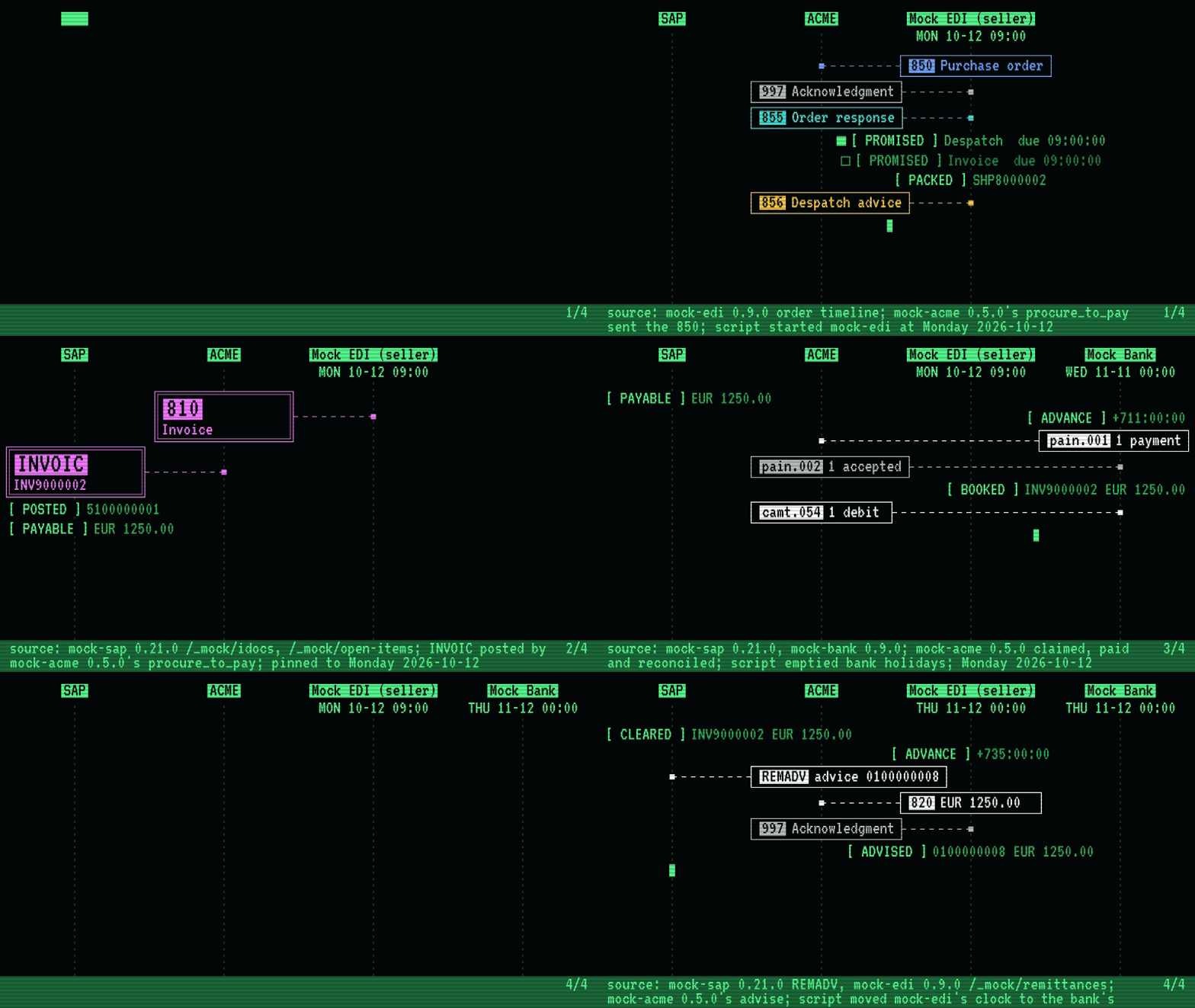
mock-films drew that film from a real run; click it to play. It has four lanes (SAP, the buyer ACME, mock-edi playing the supplier, and mock-bank), and one purchase crosses all of them:
SAP  ──850──▶  supplier          a purchase order becomes an EDI order
     ◀──855/856/810──  supplier  confirmed, shipped, invoiced
SAP  ◀──INVOIC──                 matched, posted, and now owed
     ──pain.001──▶  bank         a payment run selects what is due
SAP  ◀──FINSTA01◀──camt.053──    the statement clears what was paid
SAP  ──PEXR2002──▶ 820 ──▶  supplier   and the supplier is told what for
Every arrow in it is something one of the other worked examples already does with two mocks. PO bridge sends the order, Invoice check posts the invoice, Payment run pays it and reads the statement back, Remittance tells the supplier. Procure to pay strings them together, and it exists for what only shows up between them.
What the film shows
The run starts on Monday 2026-10-12. ACME’s 850 goes to the supplier, which acknowledges it, confirms it, packs it, sends the despatch advice, and raises invoice INV9000002. The middleware posts that invoice into SAP as an INVOIC, and SAP now owes EUR 1250.00.
Then the bank’s clock moves to Wednesday 2026-11-11, the day SAP says the invoice is due. The payment run sends a pain.001 with one payment; the bank accepts it, books it and reports the debit. The clock moves a day, Thursday’s statement arrives, the middleware posts it to SAP as a FINSTA01, and SAP clears INV9000002. On the way, 22 empty statements were posted for the days nothing happened, and the film leaves them out.
The fourth act tells the supplier. First the script moves the supplier’s clock to the bank’s day, and the film shows it doing so: a supplier still on its own clock, a month behind, would take the advice as one for money that has not arrived, and say so. Then SAP writes a payment advice from the payment, the middleware sends it to the supplier as an X12 820 for EUR 1250.00, and the supplier acknowledges it and records it as advised. That word is the supplier’s, and it means only that it was told. Nothing in the film says the supplier applied the payment to the invoice on its side.
Each pair was green while the chain was broken
The example was written to find bugs, and it found three, in code whose own tests were passing:
- An
INVOICthat named no supplier, so it posted and created nothing owed. - A mock that answered “posted” for having posted nothing.
- An order placed in EUR that came back invoiced in dollars.
None of them showed up between two mocks, because each pair’s tests check what the next system received, not what it could do with it. An invoice SAP accepts but can’t pay looks fine until something tries to pay it.
The same invoice twice
This is the one worth the whole exercise. A supplier retries an invoice after the first was taken, or a restarted middleware posts it again. Two things look like they catch it, and neither does.
Upstream, a restarted middleware has forgotten its ship notices as well as what it posted. An invoice arriving on its own names a shipment whose ship notice it no longer has, so it is held: invoice INV9000002 bills shipment SHP8000002, and no ship notice for that shipment has arrived, so it was kept for the next run. That isn’t the duplicate being caught; it’s a second thing being missing. Resend the despatch advice with the invoice, as a partner replaying a batch would, and it posts again.
Downstream, within one payment run, a second item with a reference already seen is skipped, so two payments in one file can’t share an EndToEndId. It looks caught. In the next run the first payment has cleared, the second item is alone, and it is paid.
So neither end is checking. Each is forgetting or deduplicating for its own reasons, and the second payment goes out through the gap. SAP won’t answer the question unasked either: a duplicate check in SAP is configuration, so mock-sap files both, and a mock that invented a check would hide exactly this bug.
The fix is to ask the system of record. Does SAP already hold a supplier invoice with this number, from this supplier?
def already_posted(self, reference, supplier):
    query = urllib.parse.urlencode({"$filter": (
        "SupplierInvoiceIDByInvcgParty eq '%s' and InvoicingParty eq '%s'"
        % (odata_string(reference), odata_string(supplier))),
        "$format": "json"})
    found = self.sap.request("GET", "%s?%s" % (SUPPLIER_INVOICES, query))
    return bool(found["d"]["results"])
It survives a restart because SAP is where the answer lives. It is per supplier, because an invoice number is only unique within one. And odata_string doubles any quote in the number, because O'BRIEN-014 is a supplier’s invoice number, not OData syntax.
What it doesn’t do
Until mock-acme 0.2.0 it didn’t tell the supplier it was paid, and the film ended with SAP and the bank agreeing and the supplier none the wiser. That is why a supplier keeps dunning you for an invoice you paid. The fourth act is the fix: the middleware’s advise step asks SAP for the payment advice (mock-sap writes one from the payment itself, naming every invoice it settled), converts it with remittance into an 820, and sends it to mock-edi, which says whether it agrees.
What the middleware still doesn’t do is take it back. If the bank returns a payment after the supplier was told, SAP reopens the invoice, and the supplier holds an advice saying it was paid. The correction is a reversing 820, and nothing sends one yet.
Run it
The example and its tests are in mock-acme, the package of integrations between the mocks, and its tests start the three mocks themselves:
git clone https://github.com/rseufert/mock-acme && cd mock-acme
pip install -e ".[test]"
python3 -m unittest -v tests.test_procure_to_pay
Thirty-one tests. Among them are the loop end to end, the duplicate paid without the check and refused with it, a price disagreement blocked before any money moves, a short shipment paid for what shipped, and a payment the bank rejects leaving the invoice owed. Four more are about what the payment run remembers of what it sent: that is in SAP now, so a restarted middleware does not pay again with a register of its own or without one, and a statement posted by another middleware still lets the invoice go. The last five came with the advice: the supplier is told and agrees, one advice names both invoices a single payment settled, a payment the bank refused is not advised, a payment accepted but not yet on a statement is not advised either, and the advice carries the bank’s day, which the supplier judges by its own clock. Twelve more came with mock-acme 0.5.0. Seven are about a backorder, which needs mock-edi 0.9.0: a supplier short of stock ships the rest later, and two ship notices, two invoices and two payables against one purchase order are each paid once, in one run or in two, neither taken for a copy of the other. Five are about an invoice that arrives before its ship notice: it is held, a payment run that fires meanwhile pays nothing for it, and the run after the notice arrives pays it once. The code is procure_to_pay.py, and the tests are in tests/test_procure_to_pay.py.
Checked on 4 October 2026 against mock-sap 0.16.0, mock-edi 0.7.0 and mock-bank 0.7.0.
Checked again on 5 October 2026 against mock-sap 0.17.1: the ten tests pass unchanged. 0.17.0 changed how a statement posts, with one payment document per supplier rather than one per invoice, and added the remittance advice mentioned above.
Updated 5 October 2026: the example has moved. It was in mock-bank’s examples/ and its wheel, as mockbank.examples; it is now in mock-acme, with the other integrations between the mocks, and the mocks have removed their copies. Run it says how to run it from there. Against mock-sap 0.18.0, mock-edi 0.7.0 and mock-bank 0.7.0, from mock-acme at 5f2ee3d, it is fourteen tests, OK. The ten this post described are all among them. mock-bank 0.7.0 still carries the old copy, and the release after it will not.
Updated 5 October 2026: mock-films re-cut the film with mock-acme 0.2.0’s procure_to_pay driving it, where it had run mock-bank’s packaged example. No row changed, but every date moved a week, because the run is dated the Monday after the capture: it now starts on Monday 2026-10-12 and pays on Wednesday 2026-11-11. mock-acme 0.2.0 also tells the supplier what was paid, so What it doesn’t do now says what the middleware does and what it still doesn’t. Against mock-sap 0.18.0, mock-edi 0.7.0 and mock-bank 0.7.0, from mock-acme 0.2.0 at c538e72, it is nineteen tests, OK.
Updated 5 October 2026, later: mock-films added the fourth act, so the film now ends with the supplier told, and What the film shows describes it. The supplier’s lane now shows its clock in every act; the rows and dates of the first three acts are unchanged. The film runs 65.7 seconds, up from 51.2.
Checked again on 7 October 2026 against mock-sap 0.19.0, mock-edi 0.7.0 and mock-bank 0.8.0, from mock-acme 0.3.0: nineteen tests, OK. A restarted middleware no longer needs a register to keep from paying twice, because the payment run now writes in SAP which run has each invoice, so the restart tests say so.
Checked again on 7 October 2026 against mock-sap 0.21.0, mock-edi 0.9.0 and mock-bank 0.9.0, from mock-acme 0.5.0: thirty-one tests, OK. The twelve new ones are described in Run it. One sentence above changed with them: the invoice a restarted middleware is sent alone is now held for the ship notice it names, where it was blocked for billing more than was shipped, so The same invoice twice quotes the new reason. It is still a second thing missing, not the duplicate being caught. The film is unchanged.
Updated 11 October 2026: mock-films captured the film again against mock-sap 0.21.0, mock-edi 0.9.0 and mock-bank 0.9.0, with mock-acme 0.5.0 driving it and every clock pinned. The dates and amounts above are unchanged, and so are its four acts; one row changed: the supplier’s advised row now carries the currency, 0100000008 EUR 1250.00; the document number is unchanged. It runs 65.8 seconds. Two new films from the same capture are on the examples page: one order, two deliveries, each paid once, and two suppliers with one invoice number.